
By David Weiss
The first thing you notice about golf on California’s Central Coast isn’t the golf. It’s the light.
It arrives softly over the Pacific, a kind of gauzy, cinematic glow that makes even a range bucket feel like a prop in a lifestyle shoot. By the time you’ve driven north out of Santa Barbara, past citrus groves, roadside farm stands, and the slow, tilting rhythm of vineyards, you begin to understand that golf here is less a pursuit than a mood. The fairways just happen to be very, very good.
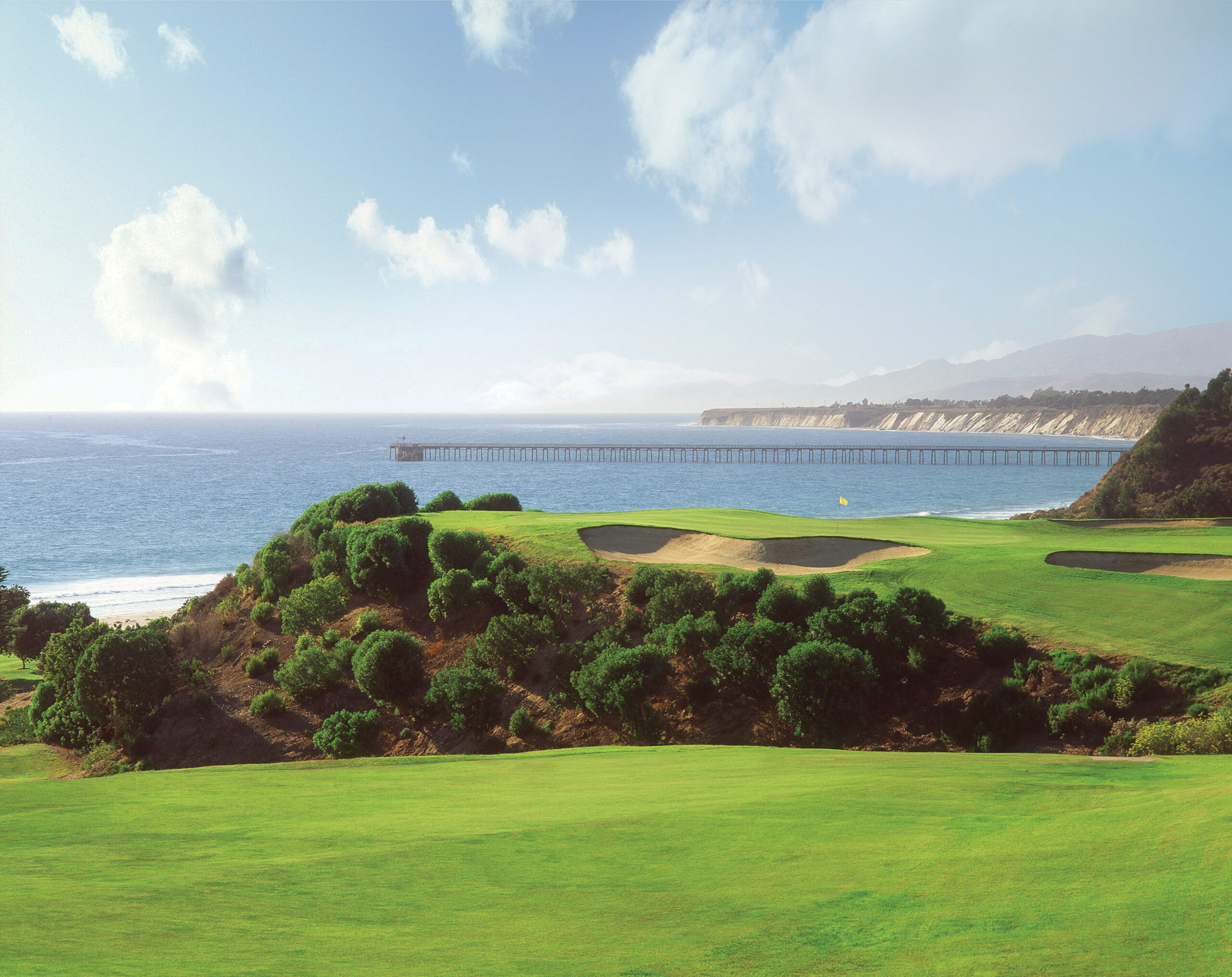
Start with the ocean because you should always start with the ocean. At Sandpiper Golf Club, the Pacific doesn’t so much frame the round as stalk it. Holes spill along the bluffs above the water, gulls circling lazily as if they’ve got tee times of their own. Designed by William Bell Jr., Sandpiper has that old-school California ease: wide corridors, strategic bunkering, greens that don’t shout but still get the better of you.
The par-3 sixth is the postcard, perched above the surf, the kind of hole that makes you briefly consider quitting your job and becoming the sort of person who lingers. Even when the wind kicks up, and it will, you’re not fighting the course so much as negotiating with it. The ocean sets the terms.
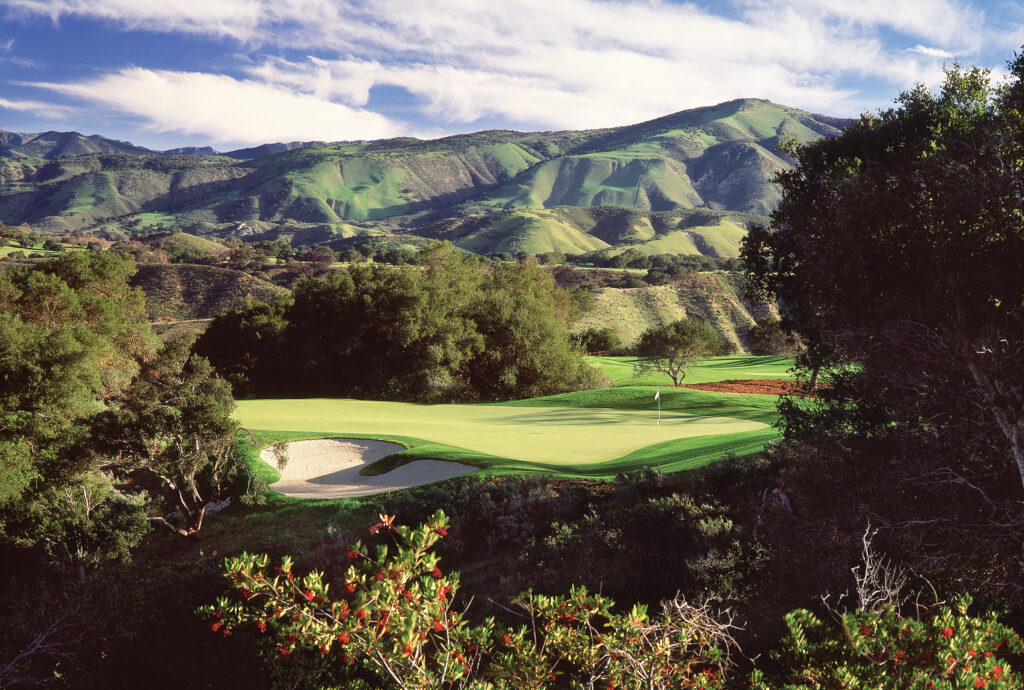
Drive inland and the mood shifts. The salt air gives way to chaparral and oak, and the land begins to roll with a different kind of authority. Rancho San Marcos Golf Course feels like a hidden chapter, tucked into the foothills, quieter, more intimate. It’s a course that rewards attention: uneven lies, subtle doglegs, greens that ask for imagination instead of brute force.
There’s a sense here that you’re playing through the land rather than over it, that each hole was discovered rather than built. It’s the kind of place where you look up after a shot and realize you haven’t heard a car in an hour.
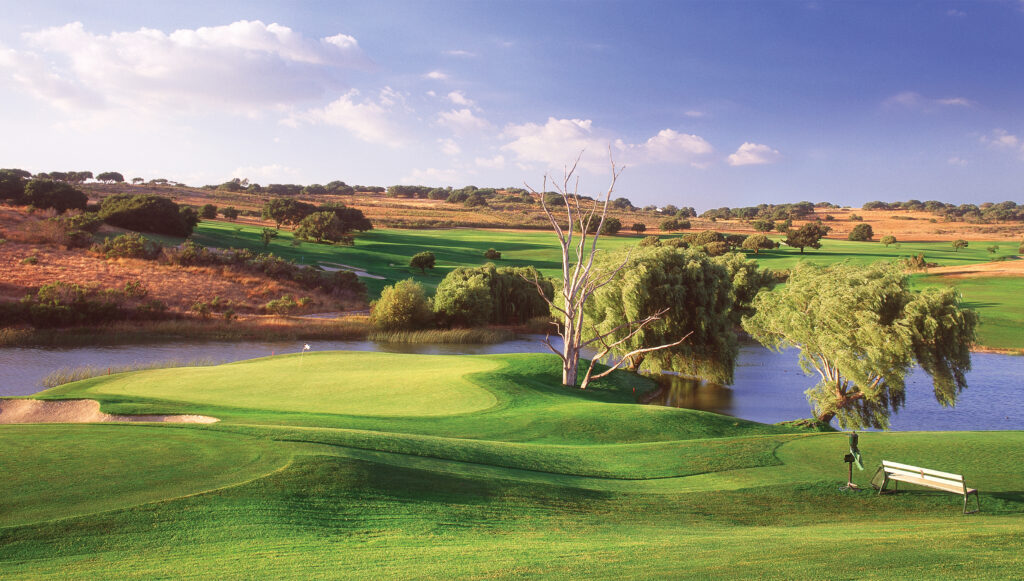
North again, and the terrain opens into something broader, windier, more elemental. La Purisima Golf Course is often spoken of in reverent tones, and for once, the reverence feels earned. Designed by Robert Muir Graves, it stretches across a wide valley like a links course that took a wrong turn and ended up in wine country. There are no houses, no visual clutter, just fescue, bunkers, and the steady insistence of the breeze.
The routing is muscular without being punishing, the greens large enough to invite hope and then quietly dismantle it. It’s a thinking player’s course, but also a feel player’s course, and occasionally a survival course when the wind decides to show off. You leave La Purisima with that rare sensation of having been tested without being scolded.

Not all Central Coast golf is so austere. Some of it leans into comfort, into a kind of cultivated ease that pairs as well with a post-round Negroni as it does with a well-struck 7-iron.
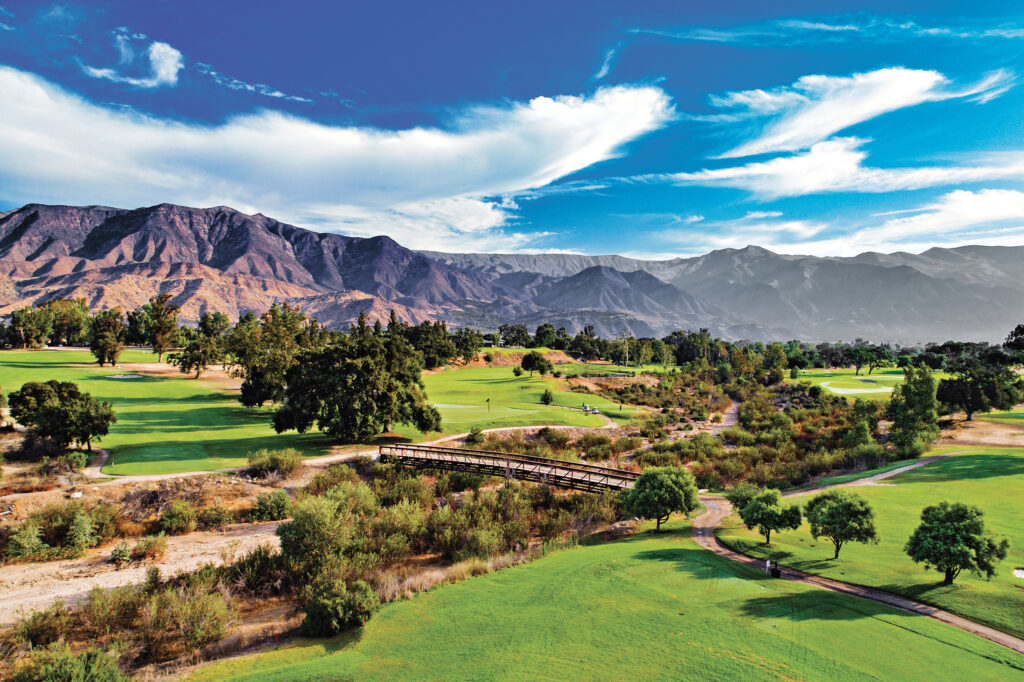
At Ojai Valley Inn, the game unfolds in a setting that feels almost improbably serene. The George C. Thomas Jr. design winds through a valley framed by the Topatopa Mountains, where the light in late afternoon turns a shade of pink so distinctive it has its own name: the “Ojai Pink Moment.”
The course itself is classic California, walkable, elegant, just demanding enough to keep you honest. But Ojai is as much about the in-between moments as the golf: the citrus-scented air, the low hum of conversation on a terrace, the sense that time has agreed to slow down for your benefit.
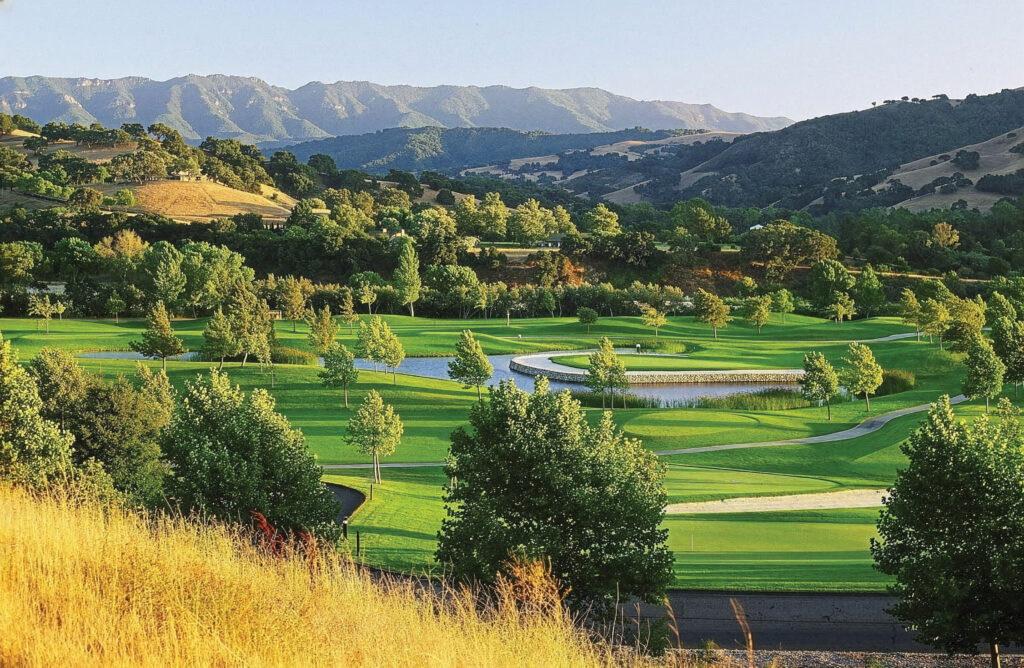
A little farther afield, Alisal Guest Ranch and Resort offers a different kind of escape, one that trades coastal chic for Western charm. Here, you can ride horses in the morning, play 18 in the afternoon, and end the day with a steak that feels like it belongs to the landscape.
The Ranch Course is the headline act, a tree-lined, creek-crossed layout that asks for precision and rewards patience. There’s something deeply satisfying about golf that coexists so comfortably with boots and saddles, as if the game has always been part of ranch life, even if it arrived fashionably late.
Then there’s Soule Park Golf Course, a municipal gem that locals speak of with a kind of protective pride. Redesigned by Gil Hanse, Soule Park has the bones—and now the polish—of something far more exclusive. Wide fairways give way to strategic angles, greens that are generous until they aren’t, and views that rival anything in the region. It’s the sort of place where you might expect pretense but find none, where a twilight round can feel as meaningful as anything you’d book months in advance.
Before you leave town, it’s worth circling back to where it all begins. Santa Barbara Municipal Golf Course (“The Muni” to locals) offers a final reminder of what makes golf here so enduring. It’s unpretentious, walkable, and quietly scenic, with mountain backdrops and glimpses of the coast that never feel forced. There’s a rhythm to The Muni that mirrors the city itself: relaxed, welcoming, and just serious enough to keep you engaged. It’s not about spectacle, it’s about feel. And in many ways, it’s the most honest round you’ll play all trip.
What ties these courses together isn’t just geography, though the proximity is part of the charm. It’s a shared sensibility, a belief that golf should be experienced, not endured. Even the more demanding layouts here seem to understand that they’re part of a larger story, one that includes food, wine, weather, and the quiet luxury of space.
Between rounds, the Central Coast makes a compelling case for lingering. In Santa Barbara, that might mean a long lunch with a view of the harbor, or a stroll along State Street where the pace feels intentionally unhurried. Head into the Santa Ynez Valley and the rhythm shifts again, tasting rooms, farm-to-table restaurants, roads that curve just enough to keep you curious. It’s easy to lose a day here, easier still to justify it.
And that may be the real trick of golf in this part of California. It invites you to play, certainly, but it also gives you permission not to rush. Tee times feel less like appointments and more like suggestions. Scores matter, but not as much as the way the light hits a fairway at 5 p.m., or the sound of the wind moving through the grass, or the simple pleasure of walking off the 18th green knowing there’s nowhere else you need to be.
By the end of a few days, you start to recalibrate your expectations. Golf doesn’t have to be a grind, or a checklist, or a test you’re always slightly failing. It can be something softer, more expansive, a way of moving through a landscape that rewards attention without demanding perfection.
On your last morning, you might find yourself back by the ocean, or tucked into a valley, or standing on a tee box with the mountains rising in the distance. The details blur a bit, the exact yardages, the number of putts, but the feeling lingers. The light, especially. Always the light.
And you realize that on the Central Coast, the golf isn’t competing with the setting. It’s collaborating with it.

