
By ED TRAVIS
Just when you have decided a soft right to left draw with the driver may be beyond your swing’s capabilities there has been a big step forward in golf club manufacturing, especially irons.
A press release from Callaway Golf, the world’s largest club maker, came across my desk announcing the company will make an investment of $15 million to build a new 3D printing facility in Fort Worth, Texas.
Well, good for Callaway and good for Texas though there was no mention of any new jobs undoubtedly some will be added.
Chip Brewer, President and CEO of Callaway Golf Company said, ” We believe 3D printing represents one of the most significant opportunities to advance golf club performance in decades, and we’re investing to lead that future.” A company spokesman opined “The future of golf performance belongs to those who never stop pushing the boundaries of what is possible.”
Callaway with revenue in the range of $3.5 billion has a long history of club innovation beginning with the S2H2 hosel in 1988 and in 1991 the Big Bertha driver that began the explosion in driver distance.
More recently they have been among the first to make use of artificial intelligence and machine learning to design variable thickness faces of drivers and now have moved on to using AI for designing entire clubs.
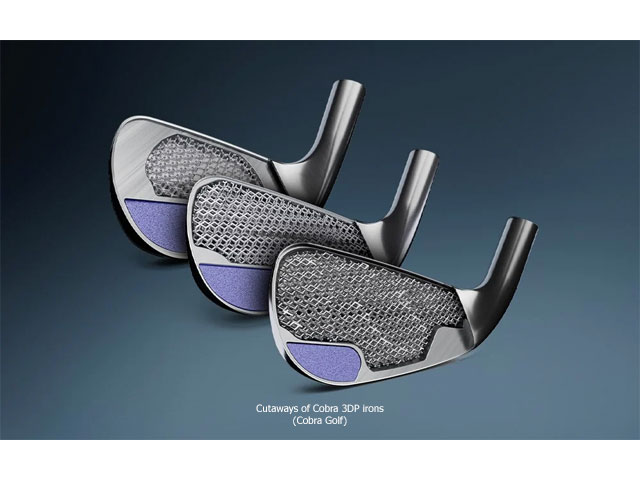
The first major club maker to market 3D printed club heads was Cobra Golf with a line of putters and last year they added a full line of irons called 3DP. While Callaway has been developing their 3D printing experience since 2022, they obviously believe it is a technology of the future with the projected 2027 opening of a dedicated Fort Worth facility.
Some smaller specialty club makers have had 3D printed irons but have had no impact on the market.
The logical question is what’s the big deal? Why is 3D printing of clubs the “technology of the future”?
It is an extremely complex process and falls into what engineers call “additive manufacturing.” Successive layers of metal powder—Cobra uses 316 stainless steel—are deposited, i.e., “printed” one upon the other. This allows an elaborate internal structure to be built up that cannot be made by the traditional manufacturing methods of casting or forging.
Instead of being hollow 3D printing meant Cobra could create iron heads with a latticework interior saving lots of weight while maintaining the structural integrity of the head. The weight was relocated to improve performance and at the same time keeping the desired head dimensions. Stability and resistance to twisting or MOI dramatically improved and that means more ball speed could be preserved on off center impacts.
Each head is made of 2,500 to 2,600 individual layers but there is another immense advantage. Prototype models that usually require new machine tools and expensive metal work can now be 3D printed by simply applying a desired change to the controlling CAD program and an experimental design is printed in a fraction of the time and cost.
Acceptance of 3D printed irons by golfers has been encouraging and it won’t be long before other club makers will follow Cobra and now Callaway. Casting and forging of iron heads which is mostly done overseas require upfront investments but have the advantage of being less expensive for large quantities however 3D printing has cost advantages in limited runs and precision internal designs.
This isn’t going way out on a limb, but we will see every major club maker manufacturing 3D printed irons in the next five to ten years probably not for their entire line but certainly premium high-performance models. Can driver components maybe even entire heads be far behind?

