
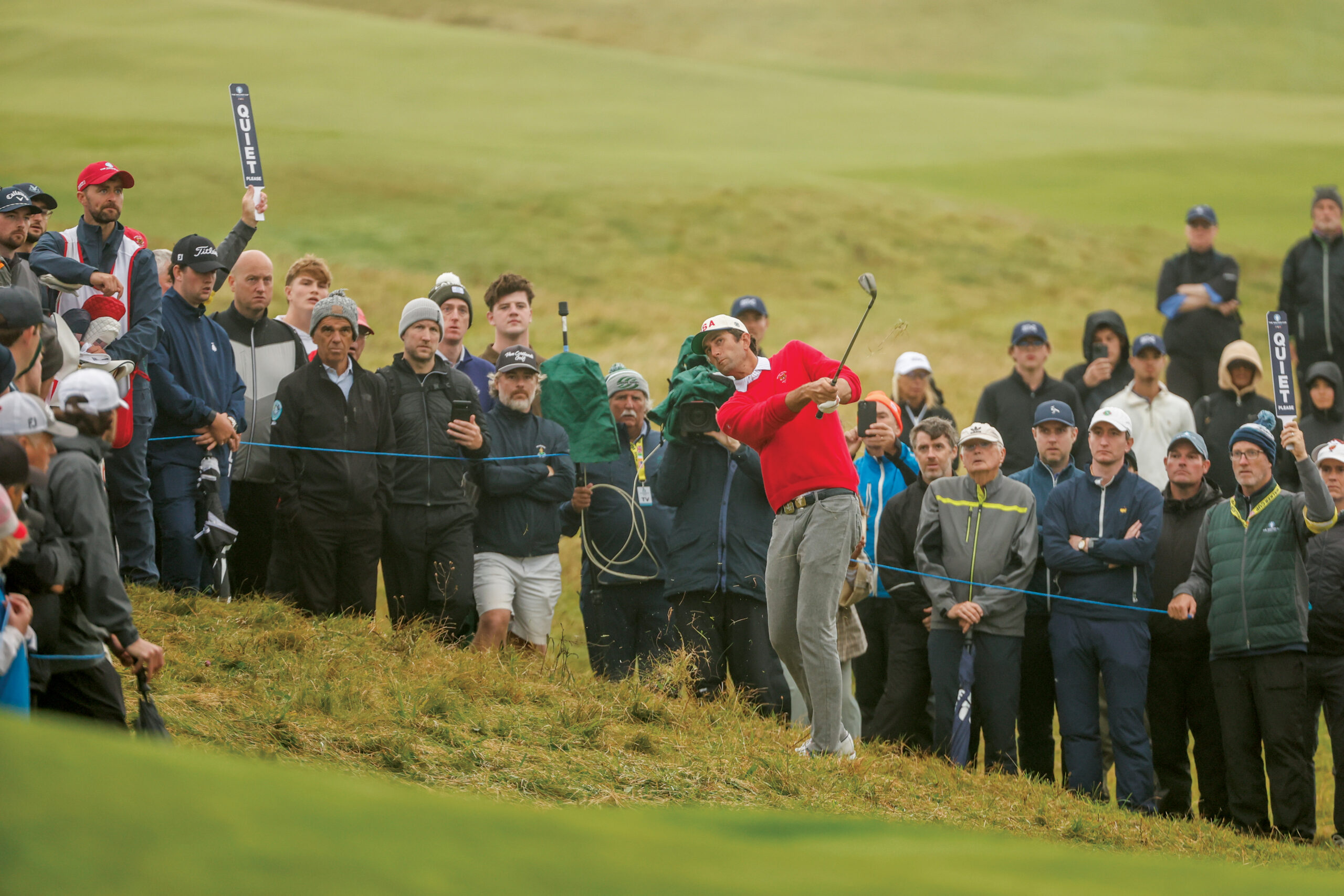
The Southern California standout has built one of the great amateur résumés of his generation, not because professional golf wasn’t an option, but because Hagestad chose a different path.
For most elite young golfers, the path seems predetermined. Receive quality instruction, excel in junior golf, compete collegiately, test yourself against the best amateurs in the country and, if you’re good enough, turn professional.
Stewart Hagestad chose a different route.
The Newport Beach native and USC graduate, whose early golf development began at Big Canyon Country Club, has built one of the most impressive amateur résumés of the modern era. He has won three U.S. Mid-Amateur Championships, competed in the Masters and U.S. Open, and represented the United States six times in the Walker Cup.
Yet Hagestad has never made the move to professional golf.
And that decision is an important part of his story.
When Hagestad graduated from USC in 2013, he didn’t believe his game was good enough to justify turning professional. Having competed alongside future professionals, he understood just how high the standard was.
“The boys that play on tour are all such impressive players, and I feel I made the right decision,” Hagestad told AmateurGolf.com in 2021. “Turning pro isn’t for everyone.”
Instead, Hagestad pursued a career in business and finance while continuing to compete as an amateur.
His development as a golfer, however, began years earlier with considerable dedication and the guidance of accomplished instructors.
Among those who influenced his early development was legendary golf instructor Jim Flick, widely regarded as one of the game’s great teachers. Between 2007 and 2009, Hagestad received instruction from Flick at the TaylorMade Kingdom in Carlsbad, California.
He also spent part of his junior golf years at the International Junior Golf Academy in Hilton Head Island, South Carolina, where he continued developing the skills that would eventually take him to USC.
Through hard work, competitive experience and quality instruction, Hagestad’s game continued to improve.
In 2016, he won his first U.S. Mid-Amateur Championship, defeating Scott Harvey on the 37th hole at Stonewall in Pennsylvania. The victory earned him an invitation to the 2017 Masters, where he became the first invited U.S. Mid-Amateur champion to make the cut, earning the Silver Cup as the tournament’s low amateur.
Suddenly, the golfer who had decided against professional golf had proven he could compete on one of the game’s biggest stages.
Still, his thinking didn’t change.
Hagestad has repeatedly explained that he loves competitive golf but also wants a life beyond the game. He continued pursuing opportunities in business and finance while earning an MBA from USC’s Marshall School of Business.
Rather than allowing golf to define his entire life, he found a way to pursue professional interests while remaining competitive in amateur golf’s biggest championships.
That balance makes his accomplishments even more remarkable.
Hagestad added U.S. Mid-Amateur victories in 2021 and 2023, giving him three national titles. Only four-time champion Nathan Smith has won more.
He has also qualified for five U.S. Opens, making the cut in 2022, and twice reached the quarterfinals of the U.S. Amateur Championship.

Then there is the Walker Cup.
Hagestad’s selection for the 2026 matches at Lahinch Golf Club in Ireland marked his sixth consecutive appearance representing the United States, an extraordinary achievement in an event traditionally dominated by college stars preparing for professional careers.
The 2026 matches ended in a narrow 13½–12½ victory for Great Britain and Ireland, but Hagestad added another singles victory to his remarkable Walker Cup record.
His California connections make the story particularly meaningful for local golf fans. He grew up in Newport Beach, played collegiate golf at USC and made his Walker Cup debut at Los Angeles Country Club in 2017. Eight years later, he helped the United States win again at Cypress Point.
Perhaps the most interesting part of Hagestad’s career is that he has demonstrated there is more than one definition of success in golf.
Professional golf offers money, recognition and the opportunity to compete against the world’s best. Hagestad chose something different: a life that combines professional ambitions away from the course with competition at the highest levels of amateur golf.
Years ago, he explained his philosophy simply: “I’d rather try to be good at lots of things in life.”
That decision hasn’t diminished his golf legacy.
It may ultimately be what defines it.
Three U.S. Mid-Amateur championships, six Walker Cup appearances, five U.S. Opens and low-amateur honors at the Masters represent an extraordinary career by any measure.
But Stewart Hagestad’s story isn’t really about a golfer who never turned professional.
It’s about a golfer who discovered that he didn’t need to.

