

Born from a different vision of what competitive golf could be, Grass League is giving talented players a stage and fans a new way to experience the game.
Professional golf has never had more money, more technology or more ways to watch. Yet for thousands of talented players, one problem hasn’t changed: finding a meaningful place to compete.
Grass League believes there is room for something different.
Two-person teams. Franchises representing cities around the country. High-stakes competition on par-3 courses. Music, food, fans close to the action and, at its home in Arizona, golf played under the lights.
But behind the entertainment is a more important story about why Grass League was created in the first place.
A DIFFERENT IDEA FOR GOLF
The story began in Arizona with four friends and passionate golfers: Jake Hoselton, Jimmy Hoselton, Connor Riley, and Pete Wilson.
They loved golf, but they didn’t necessarily identify with everything surrounding traditional golf culture. They were also fascinated by the people behind the scenes and in 2019 created Grass Clippings, originally as a golf lifestyle brand built around that perspective.
That same year they staged the first Grass Clippings Open.
The idea was straightforward: create serious competition without making the experience feel overly serious. There was music, food, entertainment and a relaxed atmosphere surrounding a par-3 tournament.
Something clicked.
Players could feel pressure over shots that mattered while spectators could experience golf differently. Instead of trying to recreate traditional tournament golf, the founders began wondering whether par-3 competition could become its own product.
There was another influence much closer to home.
Jimmy Hoselton had pursued professional golf and experienced firsthand the financial reality facing players outside the game’s major tours: travel expenses, entry fees and hotel bills can easily exceed what a player earns even when he plays well.
The founders saw an enormous pool of talented professionals and elite amateurs with compelling stories but few opportunities for fans to ever know who they were.
Grass League could give some of them a stage.
WHY PAR-3 GOLF?
The choice of par-3 golf wasn’t simply about making tournaments shorter.
The founders recognized that many of golf’s most memorable moments happen from 150 yards and in, a great iron shot, a pressure-filled chip, or a putt with something riding on it.
Eliminating the driver also changes who can compete. Distance becomes less dominant, opening the door to different ages, backgrounds and types of players.
To fully explore the idea, Grass Clippings needed its own home.
In 2023, the group entered a long-term partnership with the City of Tempe to operate Rolling Hills Golf Course. The property was transformed into Grass Clippings Rolling Hills, including lights that allow the entire 18-hole par-3 course to be played at night.
It became the home of what Grass League calls high-stakes par-3 golf.
The league has since evolved into a structured competition with franchises, player rosters, prize money, season-long points and a championship. In 2026, 11 franchises are competing, and the league also uses a qualifier and draft to create another pathway for players to earn their way onto rosters.
It is professional golf borrowing a little from traditional team sports without abandoning the competition that makes golf compelling.
TAKING THE SHOW TO CALIFORNIA
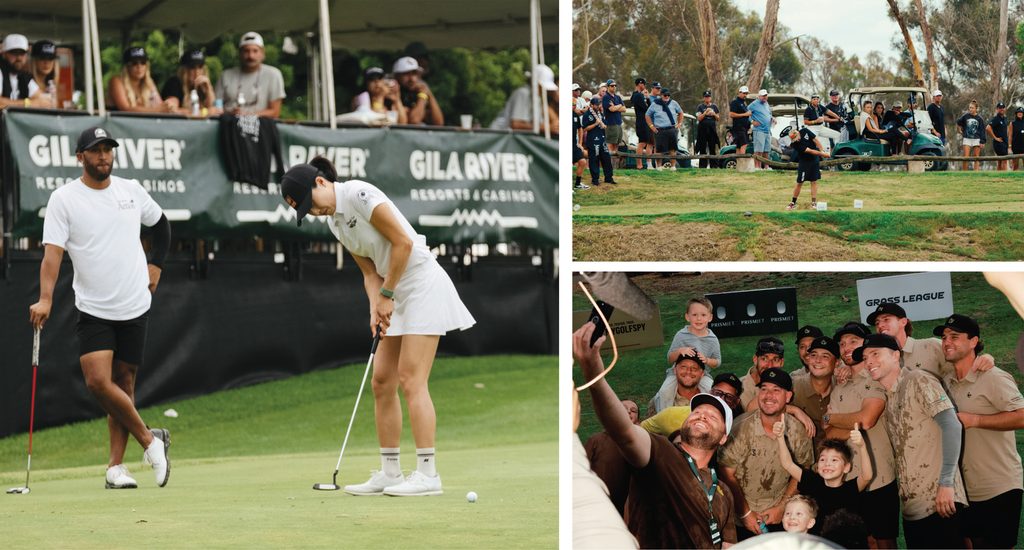
That vision came to California in September when Grass League staged its second Summer Grind at Goat Hill Park in Oceanside.
Few courses could have been a better fit.
The municipal course was nearly lost to redevelopment before John Ashworth and a grassroots community effort helped save it. Today Goat Hill embraces the philosophy “World Class, Working Class,” creating an accessible golf environment that includes opportunities for juniors and a culture far removed from the exclusivity sometimes associated with the game.
Grass League and Goat Hill are different stories, but they share a similar belief: golf can be highly competitive without losing its sense of community and fun.
At the Summer Grind, each of Grass League’s 11 franchises sent five two-player teams into the 36-hole competition.
And the players delivered.
David Bradshaw and Parker Reddig of the Scottsdale Strikers finished at 20-under par, closing with a final-round 12-under performance to win the championship.
Bradshaw’s story illustrates exactly why the Grass League concept is interesting.
The 43-year-old West Virginian has spent much of his professional career fighting for opportunities. He has won the West Virginia Open 12 times, competed on PGA Tour Canada and PGA Tour Latinoamérica and made 10 PGA Tour starts.
He never became a household name.
But he can still play.
Grass League gave him another stage on which to prove it.
That may ultimately be one of the league’s most compelling ideas.
Golf doesn’t have a talent shortage. It has a stage shortage.
Grass League is trying to build another one.
The 2026 season concludes December 4–5 with the GL Championship back at Grass Clippings Rolling Hills in Tempe. Eleven franchises will compete for the season title under the lights at the place where the concept found its home.
How large Grass League ultimately becomes remains to be seen. But its founders aren’t simply shortening golf or adding music to a tournament.
They’re experimenting with who gets to compete, how fans experience the game and what competitive golf can look like outside its traditional boundaries.
And sometimes, new ideas in golf don’t begin on golf’s biggest stages.
Sometimes they begin with a few friends, a par-3 course and the belief that there has to be another way.

